
Flueless Fireplace for a Flat: A Practical Buying Guide

A fireplace with no visible flue may need closer scrutiny than its simple appearance suggests. A vent free fireplace for apartment living can seem like an easy way to bring a welcoming glow into a smaller home, but “vent-free”, “ventless” and “flueless” don’t explain exactly how a model handles ventilation or where it can be installed.
It’s understandable to want the warmth and atmosphere of a hearth without major building work, especially when space is limited or apartment rules narrow your options. The right choice depends on more than the label: fuel, airflow, the manufacturer’s instructions and your building’s requirements all matter. Gas and bioethanol fireplaces are options to compare, but not every model in either category is designed to operate without a flue.
This guide explains the differences between fireplace types and what to consider before choosing one for a South African flat, including ventilation, indoor air, fuel and everyday safety. You’ll also find practical checks to complete before installation. Decor Fires sells and installs gas and bioethanol fireplaces, with advice on selecting a product and planning its installation around your space.
Key Takeaways
- Read “vent-free”, “ventless” and “flueless” as descriptions to investigate, not proof that a fireplace suits every flat.
- Compare gas and bioethanol options by how each model uses fuel and what its installation requires.
- Before choosing a vent free fireplace for apartment living, consider your building’s rules, the room and the manufacturer’s guidance.
- Separate essentials, such as permitted installation and suitable ventilation, from preferences such as flame appearance.
- Explore apartment fireplace options with Decor Fires’ product-selection and installation advice.
What does a vent-free fireplace for an apartment actually mean?
A gentle flame can make a compact flat feel more inviting, particularly where adding a conventional chimney or flue would be difficult. But “vent-free”, “ventless” and “flueless” describe an aspect of an appliance. They are not a blanket assurance that it can be installed in any room or apartment.
In brief: “Flueless” generally describes a fireplace that does not use a conventional chimney or flue to carry exhaust outdoors. The term alone does not confirm that a model needs no ventilation or is suitable for your home.
Fuel, appliance design and room conditions all affect how a fireplace operates. Gas and bioethanol models use different fuels and may have different installation and operating instructions. Requirements can also vary between models that use the same fuel. For a general overview of types of fireplaces, including ventless designs, read the reference alongside the manufacturer’s documentation for any appliance you are considering.
Vent-free, ventless and flueless: are they interchangeable?
Retailers and manufacturers may use these terms in overlapping ways, so don’t rely on the label alone. Read the model’s installation and operating documentation. Look for whether it requires a flue, specifies ventilation, sets conditions for the room or limits where it may be used. “No conventional chimney” and “no ventilation considerations” are not the same thing.
A product description can help identify a category, but it cannot establish that an appliance is safe or compliant in a particular setting. Suitability depends on the full instructions and the installation conditions, not on one word in a listing.
Why apartment living changes the fireplace decision
In a flat, the decision involves more than the fireplace and the wall behind it. Shared walls, neighbouring homes and limited scope for altering the building can affect where an appliance could go. Building-management rules may also place limits on installation or fuel use. Resolve these practical conditions before settling on a design.
The room matters as well. Its size, layout, airflow and the position of furnishings all affect whether a specific model can be used as directed. A fireplace that looks well proportioned in a showroom may not suit a smaller or less ventilated room. Check the manufacturer’s room and ventilation guidance, then consider how the appliance would fit into your everyday routine.
If bioethanol is one of the categories you’re exploring, this overview of indoor bioethanol fireplaces can help explain the appeal of this style. Treat the category as a starting point: confirm the individual model’s fuel, installation and ventilation requirements before choosing it.
How fuel type and ventilation shape apartment fireplace suitability
Gas and bioethanol fireplaces can both create a striking focal point in an apartment, but their fuel and installation needs differ. The category alone won’t tell you whether a particular model is flueless, what ventilation it requires or whether it suits your room. Compare the documentation for each appliance before weighing its appearance and everyday convenience.
Gas and bioethanol fireplaces: what should apartment buyers compare?
Gas fireplaces use a gas supply, while bioethanol fireplaces burn liquid fuel. Their operation, fuel handling and installation arrangements are different, and models within either category may have their own requirements. Read the instructions for the exact appliance, including whether it needs a flue, any ventilation guidance, room conditions, fuel requirements and operating directions. This gives you a more useful basis for comparison than a general product label.
Ventilation and installation requirements depend on the specific appliance, not simply on whether it is gas or bioethanol.
Gas: Find out how the model is supplied with fuel and whether its instructions specify a flue or particular ventilation. Consider the connection and installation requirements in the context of your flat.
Bioethanol: Check the specified fuel, filling and operating instructions, together with any room or ventilation guidance. Consider how fuel handling would fit your household routine.
Either category: Review the appliance documentation, intended position and relevant building-management requirements before choosing a model.
With either fuel, balance the look and feel of the flame against practical questions, such as where the fireplace can go and how you expect to use it. In a smaller flat, consider whether the intended location leaves enough room for normal movement and whether the operating instructions suit your routine. Use the product documentation to understand the requirements rather than assuming a particular fuel category guarantees a simple installation.
When a flued fireplace may be the more suitable comparison
A flued fireplace is also worth considering if your building has a suitable route for the flue and the necessary permissions can be secured. This option requires planning for the route and installation, which may be difficult in a flat with limited scope for building alterations. It isn’t automatically possible just because you prefer a flued model, so compare it with other options in light of the building’s practical constraints.
When considering built-in gas fireplace planning, think about how the fireplace would sit in the room as well as how it would be installed. Decor Fires provides product-selection and installation advice to help you weigh these factors. Explore fireplace options as you refine your shortlist.
Does a vent-free fireplace work safely in an apartment?
You can’t judge safety by the “vent-free” label alone. The term doesn’t mean every room, appliance or apartment building is suitable, and it doesn’t remove the need to consider ventilation and safe operation. Assess a vent free fireplace for apartment living against its own manufacturer’s instructions and the conditions in the room where it would be used.
In a flat, there’s another matter to resolve before choosing a model: the building’s rules. Lease terms, body corporate or building-management requirements, and relevant local requirements may affect whether an installation is permitted. Requirements can vary between properties, so understand the permissions that apply to your home before committing to an appliance.
What apartment residents should check before installation
Start with the paperwork, then assess the room. Review your lease and building rules, and establish whether written permission is required before buying or arranging installation. Consider the intended position early: it may involve shared walls, nearby furnishings or changes to the apartment.
Next, compare that position with the chosen model’s documentation. Check the stated room conditions, required clearances and ventilation guidance, along with any installation restrictions. Don’t assume an appliance suitable for one room or building will suit another. Decor Fires’ product-selection and installation advice can help you understand model requirements in relation to your apartment and plan the next steps.
Indoor air, alarms and everyday use
Appliances that burn fuel can have indoor-air considerations, and the details depend on the particular model and how it is designed to operate. Follow its instructions for ventilation, operation and room conditions rather than relying on broad claims about an entire category. If the guidance specifies an alarm or detector, use the type indicated and follow the recommended placement and maintenance instructions.
Safe use continues after installation. Keep to the appliance’s stated clearances, use only the specified fuel, and follow its directions for lighting, supervision and switching off. Pay attention to any cleaning or maintenance guidance, and don’t improvise if the instructions are unclear. These steps don’t make every model right for every apartment, but they help you assess an option responsibly.
A considered decision is part of making a fireplace feel at home. Confirm the building’s requirements, understand the model’s instructions and plan the installation around both. If those conditions don’t align, pause and reassess rather than letting a striking flame effect make the decision for you.
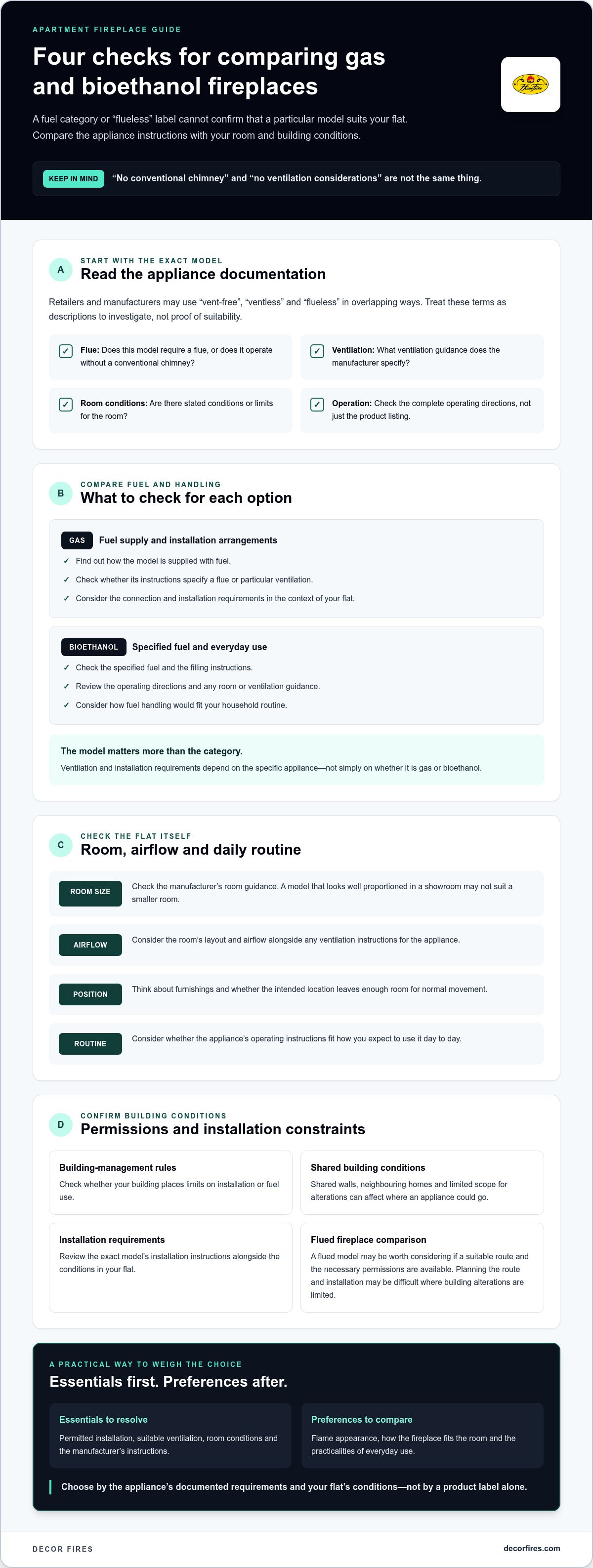
How to choose a vent-free fireplace for your apartment
A good choice starts with the conditions your apartment can accommodate, then narrows towards the flame and finish you’d like to live with. For a vent free fireplace for apartment use, treat permission, room suitability and the model’s instructions as essentials. Flame appearance, finish and footprint are preferences to weigh once those essentials are in place.
A pre-purchase checklist for apartment residents
Work through these checks in order so that an attractive design doesn’t distract from a practical restriction. Keep the building requirements and model documentation together. This makes it easier to compare options and identify unanswered questions before you commit.
- Check the apartment rules. Review your lease and building requirements, including whether written permission is needed for the appliance, fuel or installation.
- Assess the room. Record its dimensions and layout, then note where the fireplace might sit in relation to walls, furniture and everyday walkways.
- Match the model to the space. Compare the proposed position and room conditions with the manufacturer’s installation instructions, including ventilation and clearance guidance.
- Choose a fuel category. Consider gas or bioethanol in light of the model’s fuel requirements, installation details and the way you expect to use the fireplace.
- Picture daily life. Consider operating instructions, fuel handling and upkeep, as well as the flame style and design that will feel right in your home.
Apartment fireplace shortlist
- Lease and building requirements reviewed
- Room dimensions and intended position recorded
- Manufacturer instructions checked for room conditions, ventilation and clearances
- Fuel, operation and maintenance guidance understood
- Footprint, finish and flame style considered
How to compare models without relying on labels
Put the documentation for each shortlisted model side by side. Compare what each says about installation, fuel, room conditions, ventilation, clearances and operation. If an important detail is unclear, don’t treat a “flueless” or “vent-free” description as a substitute for the instructions. The model’s requirements should suit your room and the permissions available in your building.
Then picture the fireplace in use. A compact footprint may matter in a carefully furnished living area, while a particular flame effect or built-in appearance may better suit the room’s design. Consider whether the operating routine and upkeep feel manageable for your household, not just whether the appliance makes an attractive centrepiece. A useful comparison balances daily practicality with the warm, welcoming atmosphere you want to create.
Once you’ve established your must-haves and preferences, explore Decor Fires’ fireplace range and use its product-selection advice to shape your shortlist. Consider each option both in the context of your home and against the requirements of the specific model.
Explore apartment fireplace options with Decor Fires
A fireplace should feel like a natural part of your home, not a compromise that makes everyday living harder. For apartment residents, a considered choice balances the atmosphere you want with the building’s requirements, the room’s conditions and the practicalities of installation. Decor Fires sells and installs gas and bioethanol fireplaces, and provides product-selection advice to help you consider which category and model may suit your plans.
Choosing an option that suits your home and routine
Before settling on a design, bring together what you’ve learned about your apartment: the permissions available, the proposed location and the room conditions. Then compare these factors with each model’s manufacturer documentation. Requirements can vary, so neither “vent-free” wording nor a fuel category alone confirms that an appliance is appropriate for your flat.
Gas and bioethanol fireplaces have different fuel and operating arrangements, and the right comparison depends on the specific models. Consider your preferred fuel and how it fits your household routine, alongside the installation requirements and any room guidance. A striking flame effect may catch your eye, but first resolve the essential questions of permission, model suitability and installation.
Once the practical conditions are understood, there’s room for personal style. Consider whether a built-in or freestanding look suits your layout, how much visual space you want the fireplace to occupy, and whether its appearance works with your existing finishes. A considered vent free fireplace for apartment living should bring warmth and character to the room while fitting the realities of the building.
What to expect when seeking selection and installation advice
Decor Fires provides expert guidance on fireplace selection and installation. Sharing details such as your apartment layout, intended position, design preferences and known installation constraints helps make the discussion more relevant to your home. It’s also useful to have the building’s requirements and any shortlisted model documentation to hand, so practical considerations can inform the conversation alongside the look you want to create.
Installation planning should account for the requirements of the particular appliance. Product documentation can guide questions about fuel, room conditions, clearances, ventilation and operation. Advice on selection and installation helps you consider those details as part of one decision. This informed approach can make a complex choice more manageable, leaving you free to focus on the pleasure a softly glowing hearth might bring to a quiet evening or relaxed gathering.
Explore fireplace options with Decor Fires and take the next step towards finding an option that feels right for your apartment, your routine and the way you want your home to welcome you.
Make room for a more welcoming evening
A fireplace can be more than a source of warmth: it can give a flat a natural gathering point, soften the feel of a living space and make quiet evenings feel special. Turn that possibility into a considered choice by letting the needs of your home guide the design, rather than relying on the label alone.
As you explore a vent free fireplace for apartment living, keep your priorities in view: the atmosphere you want, the practical limits of your space and the requirements of the particular model. Decor Fires sells and installs indoor fireplaces, including gas and bioethanol options, and provides expert advice on product selection and installation to help you shape a choice around your home.
Let the details inform the design. Explore fireplace options for your home and take a confident first step towards creating a warm, inviting place to unwind and gather.
Frequently Asked Questions
Can I install a vent-free fireplace in a rented apartment?
Only if your tenancy and building requirements allow it, and you’ve obtained any required permission before installation. A fixed unit or changes to walls and services may need particular attention, but a freestanding appliance can also be subject to building rules. Put the approval and proposed installation details in writing, and keep them with the fireplace documentation so everyone involved understands what has been agreed.
Does a vent-free fireplace need ventilation?
Possibly. The answer depends on the appliance and its instructions. A fuel-burning fireplace can affect indoor air, so don’t assume that opening a window occasionally is an adequate substitute for ventilation guidance. Check the exact model’s operating manual for room conditions and any ventilation requirements, then follow those directions during use. If the instructions don’t fit your apartment’s layout, reconsider the model.
Is a bioethanol fireplace suitable for a small apartment?
It may suit some smaller homes, but room size alone can’t determine whether a particular model is appropriate. Compare its stated room conditions, clearances, ventilation instructions and fuel-handling directions with your space and household routine. For example, consider whether the intended position leaves enough usable room around the appliance and whether you can follow the specified fuel and operating instructions consistently. Suitability depends on the model.
Can a vent-free fireplace be used as the main heat source?
It’s generally better to regard a vent-free fireplace as supplementary rather than as the sole source of heat for a home. Its output and permitted operating pattern depend on the particular appliance, room and manufacturer’s instructions, so don’t assume it can maintain comfortable temperatures throughout an entire flat. Plan your home’s heating needs independently, and use a fireplace only as directed for the room in which it’s installed.
Do vent-free fireplaces need electricity to operate?
Not always. Electrical needs vary by model and its features. A fireplace may rely on electricity for certain controls or functions, while another model may operate differently, so the fuel type alone doesn’t settle the question. Check the manufacturer’s specifications for power requirements, plug location and what happens if the electricity supply is interrupted. This is especially useful in a flat where socket access and furniture placement can affect the intended position.
What should I check before buying a fireplace for an apartment?
First establish that your tenancy and building rules permit the appliance and proposed installation. Then prepare a short comparison file with room measurements, intended placement, the model’s instructions, fuel requirements, ventilation and clearance guidance, and any electricity needs. Note your preferences for appearance and everyday operation separately from these essentials. This makes it easier to compare a specific gas or bioethanol model against your flat’s practical limits before committing.