
Freestanding Pellet Heater: A Practical Setup and Use Guide

A freestanding pellet heater is easier to use when its position, controls and care are planned as part of one routine. Steady warmth is appealing, but it’s sensible to understand where the heater can sit, how it vents and what to do if the power goes out before you start using it.
Getting to know the main components and operating cycle makes everyday use less daunting. This guide covers the practical steps to prepare a heater, check its fuel and power requirements, and follow the startup and shutdown procedures for your model.
You’ll also find guidance on adjusting the controls, what to expect during daily use and how to build owner checks into your routine. The manufacturer’s instructions are essential throughout, because clearances, controls and maintenance requirements vary between appliances.
Key Takeaways
- Understand how pellets feed the fire and how your heater moves warmth around the room.
- Plan the position and flue around the clearances and installation requirements for your model.
- Follow the heater’s instructions for startup and use its controls to adjust the warmth gradually.
- Account for room conditions, settings and pellet use, and learn how your model responds to a power interruption.
- Make permitted owner checks part of your routine, and use the manufacturer’s guidance for cleaning and servicing.
What is a freestanding pellet heater, and how does it create warmth?
A freestanding pellet heater is a standalone appliance that burns small, compressed pellets to heat a room. Unlike a wood-burning stove, which is fuelled by logs added by hand, a pellet model commonly stores fuel in a hopper and feeds it towards the fire as needed. This creates a heating cycle managed by the appliance’s components, rather than a fire that needs to be tended by adding logs. For a general introduction to the appliance and its operation, see Pellet stove.
How the hopper, auger and burn pot work together
The hopper stores the pellets, and the burn pot is where they ignite and burn. In many models, a motorised auger moves pellets from the hopper to the burn pot. The controls may regulate the fuel feed and heat output, although the precise parts and settings vary between appliances. Use only the fuel type specified in your heater’s instructions.
As pellets burn, the appliance transfers warmth into the room. Depending on its design, it may use a fan to move heated air, radiate heat from its surfaces or combine both methods. Other components can include an igniter, a controller and a flue to carry exhaust outside. Check the manual to understand the parts and operating cycle of your particular model.
What makes a pellet heater different from a wood stove?
A wood stove is fuelled by adding logs manually, while a pellet heater commonly uses a hopper and feed mechanism to supply fuel to the fire. That changes the day-to-day routine, but neither option is automatically right for every home. Pellet appliances often rely on electrical parts, such as the auger, fans or controls. How they operate, distribute heat and need to be cared for depends on the model.
Think of the heater as a complete system: the fuel, feed mechanism, combustion area, controls and flue all contribute to its operation. Before installation or first use, follow the manufacturer’s instructions for fuel, positioning, operation and venting. If you’re considering a pellet fireplace, expert selection and installation advice can help you assess how it will suit your room and routine.
How to prepare a freestanding pellet heater for its first use
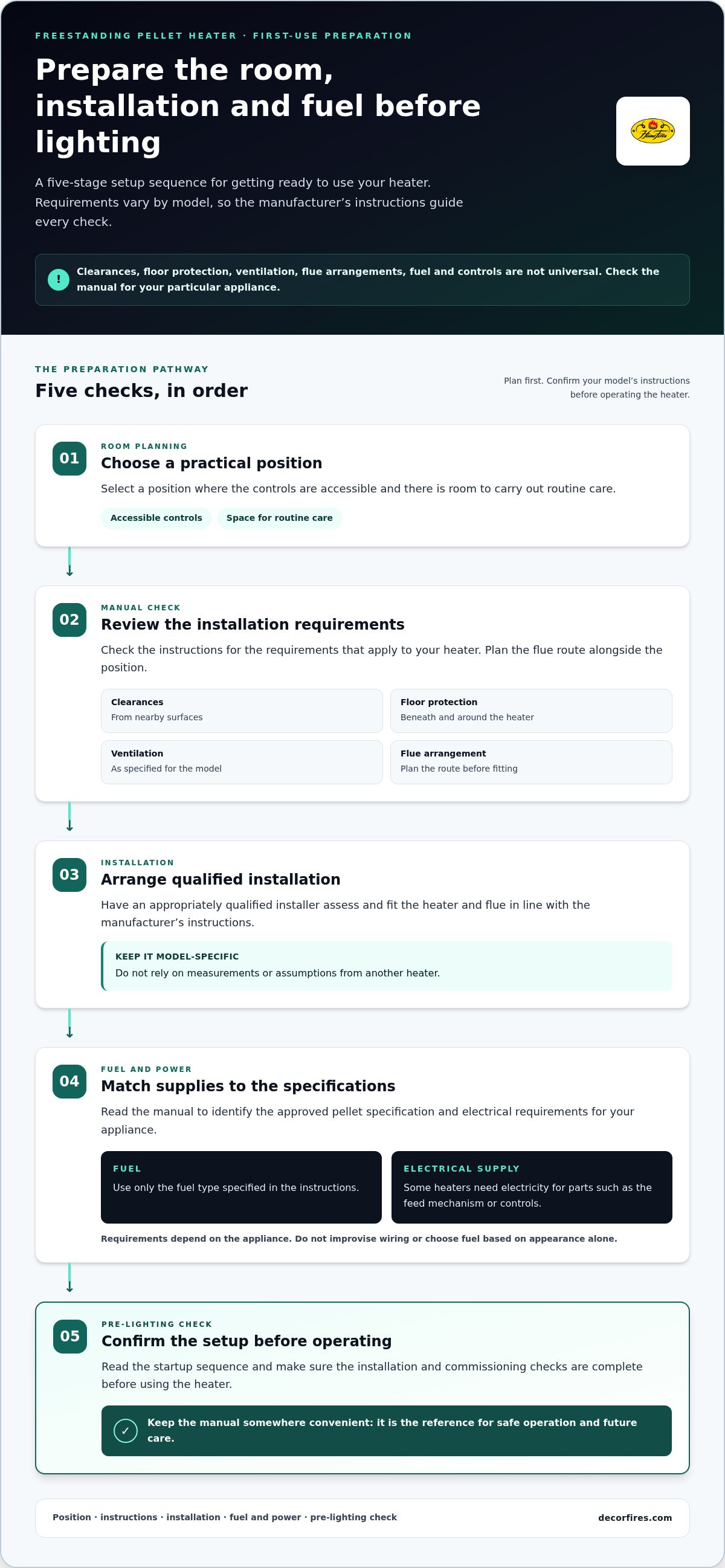
A comfortable first fire starts with planning the room and installation, not just switching on the controls. Use the manual to confirm the requirements for your specific model. Clearances, floor protection, ventilation and flue arrangements aren’t universal, so don’t rely on measurements or assumptions from another heater.
Choose a suitable position and plan the flue route
Consider whether the heater will be easy to operate and maintain in its proposed position. The controls should be accessible, and there should be room to carry out routine care. Plan the flue route at the same time, rather than choosing a position without considering where the venting needs to go.
Check the manual for requirements relating to the floor beneath and around the heater, clearances from nearby surfaces and ventilation. Have an appropriately qualified installer assess and complete the installation in line with those model-specific instructions. The Pellet stove safety and operation guide also offers useful general safety context.
Check the appliance, fuel and power requirements
Before the first fire, read the manual and identify the approved pellet specification, electrical requirements and startup procedure. Some heaters need electricity for parts such as the feed mechanism or controls. The connection and power requirements depend on the appliance, so don’t improvise wiring or choose fuel based on appearance alone.
Use this sequence to separate general planning from the checks that apply to your model:
- Plan the room: Choose a practical position with access to the controls and space for routine care.
- Review the installation instructions: Note the required clearances, floor protection, ventilation and flue arrangement for the appliance.
- Arrange installation: Have the heater and flue fitted by an appropriately qualified installer in line with the manufacturer’s instructions.
- Confirm fuel and power: Match the pellets and electrical supply to the specifications in the manual.
- Check before lighting: Read the startup sequence and make sure the installation and commissioning checks are complete before operating the heater.
Keep the manual somewhere convenient. It’s the reference for safe operation and future care. Decor Fires offers pellet fireplaces and expert product-selection and installation advice. Explore pellet fireplace selection and installation advice to plan an option for your home.
How to start, adjust and use a freestanding pellet heater
A consistent routine makes a freestanding pellet heater easier to use. Before operating it, read the manual and keep it nearby. Controls, permitted fuel and startup steps are specific to the appliance, so don’t assume that the procedure for another model will apply.
Controls and startup steps differ by model. Treat the steps below as a general guide, and follow your heater’s instructions whenever they differ.
A practical startup and shutdown routine
Start with the heater cool and switched off. Follow the manual’s checks for the burn area and fuel supply, then use the designated control to begin the cycle. Your model may have an automatic igniter, but the startup method varies. Don’t use matches, firelighters or another improvised method unless the manufacturer explicitly instructs you to do so.
- Check: Inspect the burn area and confirm the hopper contains the specified fuel, following the manual’s safety directions.
- Start: Use the normal start control and allow the programmed sequence to run. Don’t interrupt it or open parts of the heater unless instructed.
- Observe: Watch for the normal indicators as the heater settles into operation. If it displays a warning or behaves unexpectedly, consult the troubleshooting guidance.
- Shut down: Use the designated stop control and let the appliance complete its shutdown and cooling cycle. Avoid disconnecting power or opening the unit unless the instructions say it’s safe.
Using controls to maintain comfortable warmth
Controls vary. An output setting adjusts the heater’s operating level, while a temperature setting, where available, tells it the room temperature you want it to maintain. Some models may also have a thermostat or timer, but these features aren’t universal.
Make one small adjustment at a time and give the room a chance to respond. The setting that feels comfortable depends on the room, its layout and how it’s being used. A particular control position won’t necessarily produce the same result in every home. Notice how the warmth changes before making another adjustment.
For everyday confidence, let the appliance complete its normal operating cycle and use only the controls described in its manual. If a warning light, unusual behaviour or interruption occurs, follow the manufacturer’s instructions before restarting. Don’t bypass a safety feature or guess at a fix.
What to expect during daily use, including power interruptions
Everyday warmth depends on more than the heater’s setting. Room layout, insulation, draughts and the temperature you’re aiming for all affect how hard the appliance needs to work, so pellet use can change with conditions. Learning the heater’s usual operating pattern helps you plan fuel and make considered adjustments without expecting every room or model to behave alike.
Pellet use, airflow and the feel of the room
A higher heat-output setting will generally use more fuel than a lower one. A temperature-controlled heater may adjust its operation in response to the room’s conditions. Actual pellet use depends on the model, its settings and heating demand, so use the manufacturer’s information rather than relying on a universal estimate. Notice how the room warms over time, then adjust gradually.
Airflow also affects comfort. Keep the heater’s air inlets and warm-air outlets clear as directed in the manual. Avoid placing furniture or household items where they could obstruct them. If warmth feels uneven, consider whether the room layout or blocked airflow could be affecting heat distribution before changing several settings at once.
What a power cut may mean for a pellet heater
Some pellet heaters depend on electricity for components such as the pellet-feed mechanism, fans or controller. If the power is interrupted, one or more components may stop. The appliance’s response and shutdown behaviour depend on its design, so don’t assume it will continue heating or restart automatically.
Keep the manual accessible and follow its instructions during an outage and before restarting the heater. Don’t open the appliance, interfere with its controls or attempt an improvised restart. If power cuts are a regular consideration in your home, factor them into fireplace selection. Decor Fires’ guide to choosing a fireplace for power cuts offers a broader perspective, and you can explore fireplace selection advice when weighing up options for your space.
How to care for a freestanding pellet heater and get expert guidance
The right care routine depends on the appliance, how often it’s used and the pellets it burns. Separate the checks and cleaning permitted by the manufacturer from servicing or repairs that need an appropriately qualified professional. Your manual should explain what you can safely do, which materials to use and how often to carry out each task.
A simple routine for ash, glass and visible components
Let the heater cool fully before cleaning. Follow the manual’s directions for removing ash and cleaning the glass, and use only approved tools or materials. A method that suits one model may not be safe for another. Cleaning frequency can vary with use and fuel, so follow the manufacturer’s schedule rather than relying on a universal interval.
A simple owner-check routine can help you notice changes:
- Check visible areas: Look for ash build-up or obstructions around accessible parts, as described in the manual.
- Clean permitted components: Remove ash or clean the glass only as instructed, with the heater fully cool.
- Look for changes: Take note of visible damage, unusual sounds, warning indicators or changes in normal operation.
- Pause if something seems wrong: Stop using the appliance if you notice damage or abnormal behaviour, and seek suitable professional assistance rather than attempting a repair yourself.
When professional advice can make ownership easier
Inspection, servicing and repair can involve work beyond routine owner care. An appropriately qualified professional can handle technical work. Expert product-selection and installation advice can also help you match a pellet fireplace to your home and plan its position and installation requirements. For background before choosing, read Decor Fires’ pellet fireplace buying guide.
Following the model’s instructions makes it easier to keep care tasks manageable and understand when professional help is needed. Explore Decor Fires’ pellet fireplace range and guidance to compare options for your home: discover pellet fireplace options.
Make dependable warmth part of your daily routine
A freestanding pellet heater is easier to live with when its position, operation and care work together. Follow the model’s instructions for installation, fuel and startup, then adjust the controls gradually as you learn how your room responds. Keep routine cleaning to the tasks the manufacturer permits, and leave technical servicing or repairs to an appropriately qualified professional.
Power needs and everyday performance vary by appliance, so learn how your heater responds to an interruption before you need to manage one. Familiarity with its normal cycle can help you settle into a comfortable routine and enjoy the warmth it brings to your home.
Decor Fires sells pellet fireplaces and freestanding fireplaces, with expert product-selection and installation advice. Explore Decor Fires’ pellet fireplace guidance and range to find an option for your home.
Frequently Asked Questions
How does a freestanding pellet heater work?
A freestanding pellet heater burns compressed wood pellets to create heat. Pellets are stored in a hopper and, in many models, an auger feeds them into a burn pot, where combustion takes place. Depending on the design, the heater may distribute warmth using a fan, radiating surfaces or both. Controls and components differ between appliances, so use the manufacturer’s instructions to understand your model’s fuel, operating cycle and safe use.
Can a freestanding pellet heater work without electricity?
Most freestanding pellet heaters rely on electricity for components such as the pellet-feed mechanism, fans or electronic controls, so they may not operate during a power cut. Designs vary, and some may have a battery backup or different operating arrangements. Check your appliance manual for its electrical requirements and outage guidance. Don’t assume the heater can be lit or run manually unless the manufacturer describes a safe procedure.
How do you start a freestanding pellet heater?
Follow the startup sequence in the manual for your specific heater. Typically, you’ll check the burn area and fuel supply as directed, then use the designated control and allow the appliance to complete its start cycle. The exact checks and control steps vary by model. Don’t light pellets with matches or firelighters, or interrupt the cycle, unless the manufacturer explicitly instructs you to do so. Use the stated shutdown procedure, too.
What pellets should you use in a pellet heater?
Use only the pellet type and specification approved in your heater’s manual. Fuel requirements can differ between models, and pellets that look similar aren’t necessarily suitable for every appliance. The manufacturer’s guidance may specify characteristics such as pellet size or quality. Using the specified fuel helps the heater operate as intended and can affect ash build-up and cleaning needs. Don’t assume a general pellet recommendation applies to your model.
How often should you clean a freestanding pellet heater?
Cleaning frequency depends on how often you use the heater, the fuel and the manufacturer’s instructions. Consult the manual for the schedule and for which tasks an owner may carry out, such as permitted ash removal or glass cleaning. Always let the appliance cool fully first and use only approved cleaning materials. Servicing, repairs and work on components beyond routine owner care should be handled by an appropriately qualified professional.
What happens if a pellet heater loses power while running?
If power is interrupted, electrically operated parts such as the auger, fans or controller may stop. What happens next depends on the heater’s design: it may begin a particular shutdown sequence, and its restart procedure may also be model-specific. Follow the manual’s outage instructions and wait until it’s safe to restart. Don’t disconnect power, open the appliance or attempt an improvised restart unless the manufacturer directs you to.
Does a freestanding pellet heater need a flue?
A pellet heater generally needs a flue or venting system to carry combustion exhaust outside, but the required arrangement depends on the appliance. Follow the manufacturer’s instructions for flue components, routing, clearances and ventilation, and have installation completed by an appropriately qualified installer. Don’t assume a flue designed for another heater will suit your model. Resolve the installation requirements for your appliance before using it.