
Outdoor Pizza Ovens: A South African Buying Guide for 2026

The best outdoor pizza ovens aren’t necessarily the ones with the longest feature list. They’re the ones you’ll enjoy using on an ordinary evening as well as when friends gather for a braai. Choosing between wood-fired and gas-fired models can feel like a choice between the pleasure of tending a fire and a simpler cooking routine. Space, setup and upkeep matter too.
Think about how you’ll use the oven most often. If managing a live fire is part of the occasion for you, a wood-fired model may suit. If you’d rather spend less time tending the fire, consider gas. In either case, check that the oven fits your outdoor space and is comfortable to operate and care for.
This guide compares fuel types and practical features to help you choose. You’ll find questions to ask about capacity, placement, ease of use and maintenance, as well as what to check before setting up outdoors, including relevant fire restrictions. We’ll also cover pizza-making accessories that can complement your setup.
Key Takeaways
- Choose an oven that suits the cooking routine you’ll enjoy repeating, rather than focusing only on its features.
- Compare wood-fired and gas-fired models against how much time and attention you want to give cooking.
- Measure your space and check the oven’s dimensions, cooking area and setup instructions before choosing.
- Confirm fuel, fit, placement and maintenance requirements before you buy.
- Consider dough-preparation accessories, such as a dough cutter or tray, if they suit the way you make pizza.
Outdoor pizza ovens: what they do and what to decide first
An outdoor pizza oven is designed for baking outdoors, with a cooking floor beneath an enclosed chamber. The fuel, size and operating style vary by model, so start with the way you plan to cook rather than assuming one type suits every home. Bringing pizza-making outside can make a meal feel social, but the oven still needs to work for your usual routine, not only for special occasions.
A pizza oven and a braai can both be part of outdoor entertaining, but they’re designed for different cooking experiences. A braai is commonly used for grilling and gathering, while a pizza oven is built around baking on a hot cooking surface. One doesn’t have to replace the other. Consider the dishes you enjoy making and how each appliance could fit into your outdoor space.
What makes an outdoor pizza oven different?
The chamber surrounds the cooking area, and the cooking floor supports the pizza as it bakes. Together, these features direct heat around the food as well as from beneath it. Traditional wood-fired ovens use related principles, explored in this overview of traditional masonry ovens. Results depend on the particular oven, how the dough and toppings are prepared, and how the oven is operated. An oven alone can’t guarantee a particular crust or bake.
Which questions should buyers answer first?
Picture a typical meal, not just a special occasion. Will you cook for your household now and then, or regularly serve a larger group? How many pizzas would you want to prepare while people gather? Your answers help you compare cooking areas and capacity without choosing an oven that’s larger than your routine calls for.
Next, decide where the oven will stand and where you’ll keep it when it’s not in use. Measure the available space, then check the oven’s dimensions and the manufacturer’s instructions for its operating position. A compact patio and a larger outdoor kitchen may need different arrangements. Include the route to the cooking spot in your measurements, not just the final position.
Finally, consider how involved you want to be while cooking. Wood-fired cooking may suit you if tending a live fire is part of the occasion. A gas-fired model may be a better match if you prefer a simpler routine. Neither is automatically right for every host.
Your first-decision checklist:
- Choose the fuel that fits your preferred level of involvement.
- Estimate how often you’ll cook and how many people you usually host.
- Measure the intended position and check access, storage and setup requirements.
- Compare the oven’s capacity with your needs rather than assuming the highest specification is the best fit.
Wood-fired or gas-fired outdoor pizza ovens: compare the cooking experience
Fuel affects more than how an oven operates. It shapes how involved cooking feels and what you need to prepare beforehand. Neither option is automatically better. Ask yourself whether you want managing a fire to be part of the gathering, or would rather focus more of your attention on preparing and serving food.
- Fuel: Wood-fired ovens use the type of wood specified by the manufacturer. Gas-fired ovens use the gas type and connection stated for that model.
- Preparation: Wood cooking involves organising the permitted fuel and preparing the fire. Gas cooking involves checking the required supply and connection.
- User involvement: A wood-fired oven suits cooks who enjoy tending a live fire. A gas-fired model may involve fewer fire-tending tasks, depending on its design.
- Everyday convenience: Where a model supports it, gas controls may make heat adjustment more straightforward. With either fuel, read the operating instructions and allow for the preparation and care the oven requires.
When does a wood-fired oven suit your routine?
Choose wood-fired cooking if building and tending a fire feels like part of the pleasure of hosting, rather than a task you’d rather avoid. The fire can add to a relaxed outdoor meal, but factor in where you’ll store fuel, how you’ll prepare it and what cleaning the oven needs afterwards. Check which fuel the specific oven permits and follow its operating instructions.
When might a gas-fired oven be a better fit?
If you’d rather not tend a live fire, a gas-fired oven may suit your routine. Some models have ignition and heat controls, but features vary. Check how each model works, which gas type it requires, what connection it needs and which components are included. Gas may make the routine feel more straightforward, but it offers a different cooking experience from using a wood fire.
Use your usual hosting pattern to guide the choice. If tending a fire is part of the occasion you look forward to, wood may feel rewarding. If you value a simpler approach to managing heat, compare gas models and their specific controls. For either fuel, follow the manufacturer’s guidance for siting and safe operation, and consult your local municipality about any relevant fire-safety or smoke restrictions.
Once you know which routine suits you, browse the outdoor cooking collection and check each product’s fuel details and specifications before deciding.
Compare outdoor pizza oven features, size and practical setup
Look beyond appearance when comparing ovens. Check the footprint, cooking area and setup requirements against the way you plan to host. A practical fit should work for a quiet meal as well as a lively gathering outdoors.
How much space and capacity do you need?
Measure the intended position and the route the oven must take to get there. Include the space around the appliance required by its manufacturer, rather than measuring only the base. A narrow access path, steps or a compact patio can affect which oven is manageable, even if the final position seems large enough.
Next, compare the cooking area with your usual portions and hosting plans. Consider whether you’ll cook pizzas one at a time or want room to prepare food for a group. Check the product listing for the actual cooking surface and external dimensions. Don’t estimate capacity from photographs or assume a larger cooking area will suit your routine better.
Plan for storage and weather protection as well. Outdoor conditions and care requirements differ between products, so check the manufacturer’s guidance before deciding where the oven will stay when it’s not in use.
Which safety and maintenance details should you check?
Follow the manufacturer’s instructions for the supporting surface, ventilation, clearances and safe operation. A stable, suitable surface helps keep the oven in its intended position, while the specified clearances and ventilation requirements determine where it can operate. Don’t apply a general rule from another model, because requirements can vary.
Before buying, confirm the practical details on the specific product listing. Use this checklist:
- Size and access: Compare the external dimensions with your measured space and access route.
- Cooking area: Match the stated surface to the portions and occasions you have in mind.
- What’s included: Check which components come with the oven and whether additional items are required.
- Assembly and connections: Verify assembly needs and, for a fuel-connected model, the stated fuel and connection requirements.
- Care and support: Find the cleaning and maintenance instructions, then check any warranty and support details provided for that product.
Separate confirmed specifications from details you still need to verify. If a listing doesn’t state a dimension, included component or care instruction clearly, check the product information before making assumptions. Comparing these details helps you judge outdoor pizza ovens by practical fit, not just appearance or a headline feature.
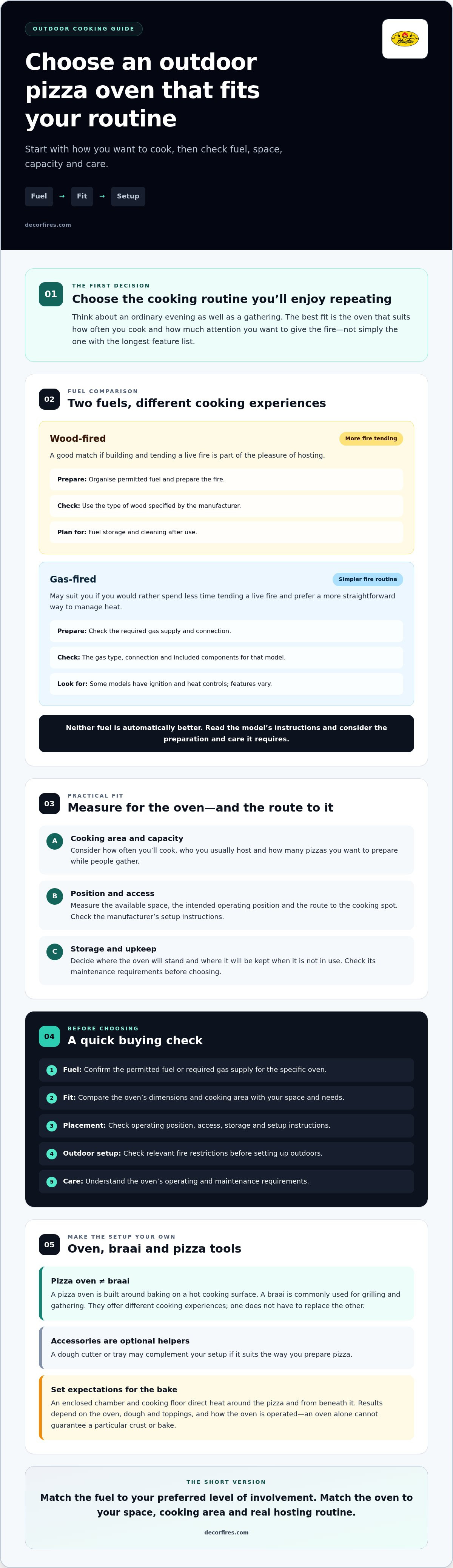
Avoid common outdoor pizza oven buying mistakes
A feature-rich oven can still be the wrong choice if it doesn’t suit your space or cooking habits. Before comparing models, work through a few practical checks. This keeps the decision focused on the meals you’ll actually make, rather than a specification that sounds impressive but adds little to your routine.
What should you verify before ordering?
Use this sequence to catch common mismatches before you commit:
- 1. Measure: Record the intended footprint and the route to reach it, including narrow passages or steps. Compare those measurements with the oven’s listed dimensions.
- 2. Choose your fuel: Decide whether wood-fired or gas-fired cooking better suits your routine. Check the specific oven’s approved fuel and, for gas models, verify the stated gas type and connection requirements.
- 3. Check the setup: Read the manufacturer’s instructions for placement, clearances and ventilation. Confirm assembly requirements and whether the components needed for operation are included.
- 4. Verify the details: Check the product listing for the cooking area, included parts and any specifications that matter to you. Confirm delivery, returns and support terms directly with the retailer rather than assuming they’re the same across products.
- 5. Plan for care: Find out how to clean and maintain the cooking surface and exterior. Consider where the oven and any required fuel will be stored between uses.
Storage and preparation are easy to overlook. If setting up or caring for the oven feels inconvenient, you may be less inclined to use it regularly. Factor those tasks into your decision, just as you would the cooking itself.
How can you choose for how you actually cook?
Picture an ordinary occasion, such as a relaxed family meal or friends dropping by for a braai. Think about how often you’ll cook, how many people you tend to host and which steps you want to enjoy, from tending a fire to adjusting heat. Prioritise features that make that likely routine easier, rather than focusing on the longest list of specifications.
The best fit is an oven you can accommodate, operate and look after comfortably. Once you’ve written down your priorities, compare available pizza oven products and check each listing against them. This keeps your search for outdoor pizza ovens focused on a practical match, not a headline feature alone.
Complete your outdoor pizza setup with the right oven and tools
Once you’ve chosen a fuel type and confirmed that an oven fits your space and setup, consider the preparation that happens before the pizza reaches the cooking surface. Suitable tools can make dough handling more organised, but accessories are additions to your routine, not a substitute for choosing the right oven.
Which pizza-making accessories can support preparation?
The supplied collection identifies the Gozney Dough Cutter and Gozney Dough Tray as pizza-making accessories. A dough cutter can support dividing and handling dough. Check its current product listing for its stated uses and details. It’s a preparation tool, not an oven, and its presence doesn’t mean a particular oven is included.
The Dough Tray is also an accessory, not a cooking appliance. Before relying on it for proofing or fermenting dough, or on features such as an airtight seal, pressure release valve or temperature gauge, confirm those details on the current listing. Product descriptions can change, and the supplied information doesn’t confirm those specifications. Check the dimensions and care instructions as well, to see whether the tray suits your preparation habits.
Keep compatibility in perspective. Dough tools support preparation, but don’t establish whether an oven and accessory work together. Check product information for compatibility guidance before ordering.
What is the next step after choosing your criteria?
Bring your priorities together: select the fuel that suits your cooking style, confirm the oven’s dimensions and setup requirements, then decide whether preparation tools would be useful. This gives you a clear view of the whole routine, from shaping dough to serving pizza outdoors.
Before ordering, verify the exact product name, specifications and availability on each live listing. Compare the stated details with your notes, and check anything unclear rather than assuming an accessory or feature comes with an oven.
Ready to compare options? Browse the outdoor pizza collection and review the individual listings to see which outdoor pizza ovens and preparation accessories match your plans.
Choose an oven that makes outdoor cooking a pleasure
The right oven is one that fits the way you cook and host. Decide whether wood-fired or gas-fired cooking suits your routine, then check the oven’s dimensions, placement and operating requirements against your outdoor space. A thoughtful fit matters more than choosing the model with the longest feature list.
Before adding tools, consider how you prepare dough and which accessories could make that part of the occasion easier. Decor Fires sells wood-fired and gas pizza ovens, as well as pizza preparation accessories. Check current product listings for names, specifications and availability, and treat accessories as separate items unless a listing confirms otherwise.
When you’re ready, browse the available products and find the right fit for your outdoor cooking style. Compare each option with your notes to choose outdoor pizza ovens that suit your space and the way you plan to cook.
Frequently Asked Questions
Is a wood-fired or gas-fired outdoor pizza oven better?
Neither fuel is best for every cook. The right choice depends on the experience you want. Wood-fired cooking suits people who enjoy building and tending a live fire, while gas may appeal if you prefer a more straightforward approach to adjusting heat, where the model supports it. Compare preparation, fuel storage and care requirements too. Check each oven’s approved fuel, controls and instructions rather than assuming features are the same across models.
Can you use an outdoor pizza oven in a covered area?
Use an oven in a covered position only if its manufacturer explicitly permits it and the required ventilation and clearances can be met. A roof or enclosure can affect airflow and smoke dispersal, so don’t assume a covered patio is suitable. Follow the model’s operating instructions and check relevant municipal by-laws or fire restrictions in South Africa. If the guidance doesn’t clearly allow your proposed position, ask the retailer or manufacturer before use.
How much space do you need for an outdoor pizza oven?
There’s no single space allowance that suits every oven. Measure the appliance’s external dimensions, the route it must travel to reach its position and the clearances specified by the manufacturer. Make sure the proposed surface is stable and suitable, and allow for any space needed during operation. Compare the cooking area with the portions you expect to prepare, then consider storage and weather protection according to the oven’s guidance.
What should you look for when buying an outdoor pizza oven?
Start with fuel and routine, then check dimensions, cooking area and whether the oven suits the number of people you usually host. Read the setup guidance for placement, ventilation and clearances. Confirm the approved fuel, connection requirements, included components and assembly needs on the specific listing. Review cleaning instructions and the retailer’s stated delivery, returns, warranty and support terms too. The most elaborate specification isn’t necessarily the best fit for your space or habits.
Do outdoor pizza ovens need a chimney?
It depends on the oven’s design. Some models have a flue or chimney, while others may use a different exhaust arrangement. Check the product specifications and manufacturer’s instructions rather than assuming a chimney is required or can be added. Follow the stated installation position, ventilation and clearance guidance, and don’t alter or obstruct exhaust components. Consider how smoke will disperse where you plan to cook, particularly in a covered or built-up outdoor space.
What accessories do you need for an outdoor pizza oven?
Useful accessories depend on the oven and how you prepare your pizzas, so first check what the product includes and recommends. The supplied collection information identifies a dough cutter and dough tray as accessories. They’re preparation tools, not ovens, and their presence doesn’t confirm compatibility with a particular model. Verify current listing details, dimensions and care instructions before choosing an accessory.
Are wood-fired outdoor pizza ovens difficult to maintain?
Maintenance depends on the oven’s materials and design. Follow its instructions for cleaning the cooking surface and exterior, handling fuel residue and storing the appliance between uses. Plan for those tasks before buying, especially if you want to cook often. Use only the fuel specified by the manufacturer and don’t improvise cleaning methods, as care guidance can differ between models.